web analytics
Connect with us

Rilis

1Billion Rising Indonesia

Published

on

one billion rising

ONE BILLION RISING INDONESIA – BACKGROUNDER *

Apa itu One Billion Rising? Satu dari tiga perempuan di dunia mengalami perkosaan atau kekerasan dalam hidupnya. Satu miliar perempuan menjadi korban kekerasan adalah sebuah kekejaman. Satu miliar perempuan menari adalah sebuah revolusi.

Pada Peringatan ke 15 V-Day, 14 Februari 2013, ONE BILLION RISING Internasional mengundang SATU MILIAR perempuan dan siapa saja yang peduli untuk WALK OUT, MENARI, BANGKIT, dan MENUNTUT penghentian kekerasan terhadap perempuan. ONE BILLION RISING akan menggerakan dunia, mengaktifkan perempuan dan laki-laki di setiap negara. V-Day ingin dunia melihat kekuatan kolektif kita, jumlah kita, dan solidaritas lintas batas kita.

ONE BILLION RISING adalah Gerakan global.
Ajakan untuk menari, Seruan untuk laki-laki dan perempuan untuk menolak berpartisipasi dalam status quo sampai perkosaan dan budaya perkosaan berakhir.
Aksi solidaritas, menunjukkan kepada perempuan tentang kesamaan perjuangan dan kekuatan mereka dalam jumlah. Penolakan untuk menerima kekerasan terhadap perempuan dan anak perempuan sebagai sebuah takdir.
Jaman yang baru dan cara yang baru menjadi manusia.

Mengapa kita bergabung dengan One Billion Rising?

Secara statistik, jumlah kasus kekerasan terhadap perempuan tidak jauh berbeda dari segi jumlah. Namun kekerasan terhadap perempuan di Indonesia adalah sebuah fenomena gunung es, dimana hanya sedikit kasus yang terlaporkan secara resmi. Perempuan memilih diam dan tidak melaporkan kasus kekerasan yang menimpa mereka dikarenakan banyak hal: sistem pelaporan dan perlindungan terhadap korban yang tidak berpihak terhadap korban dalam praktek hukum di Indonesia, stigma dan paradigma sosial yang menyalahkan korban kekerasan terutama kekerasan seksual, serta problem-problem psikologis lainnya.

Menurut catatan Komnas Perempuan, sepanjang tahun 2011 ada 119.107 kasus kekerasan terhadap perempuan yang dilaporkan, dimana 4311 diantaranya adalah kasus kekerasan seksual. Sepanjang 2011 – 2012, banyak kasus perkosaan yang diberitakan oleh media dan mendapat perhatian dari masyarakat.

Beberapa kasus yang mendapat banyak sorotan adalah kasus perkosaan di angkutan umum yang marak terjadi, salah satunya adalah perkosaan dan pembunuhan terhadap Livia, seorang mahasiswi, oleh lima laki-laki. Oktober tahun lalu, seorang siswi SMP di Depok juga mengalami perkosaan. Saat tulisan ini ditulis, media melaporkan kasus perkosaan terhadap siswi kelas 5 SD (berusia 11 tahun) yang mengalami koma dan akhirnya meninggal dunia.

Kasus perkosaan dan kekerasan terhadap perempuan adalah sebuah krisis global. Terjadi di semua negara di seluruh dunia, terhadap satu di antara tiga perempuan dari berbagai latar belakang yang berbeda. Maka menjadi tugas dan tanggung jawab kita bersama untuk berjuang secara kolektif untuk menghentikan kasus-kasus kekerasan terhadap perempuan.
Sudah saatnya kita berhenti bersikap tidak peduli, sebab saya, anda, saudara perempuan, ibu, tante, anak perempuan, istri, kekasih kita bisa menjadi korban kapan saja.

Itu sebabya kita, ONE BILLION RISING INDONESIA akan bergabung bersama jutaan perempuan, laki-laki dan semua yang yang peduli untuk bangkit dan berteriak ‘CUKUP SUDAH!” terhadap kekerasan terhadap perempuan.

Apa yang akan kita lakukan di Indonesia?

ONE BILLION RISING INDONESIA akan mengadakan V-Dialogs di beberapa tempat di Jakarta untuk bicara tentang kekerasan terhadap perempuan dan bagaimana membangun sebuah gerakan untuk menghentikan segala bentuk kekerasan terhadap perempuan. Selain V-Dialogs, ONE BILLION RISING INDONESIA juga akan mengadakan beberapa screening film.

Sebagai puncaknya, pada tanggal 14 Februari 2013, ONE BILLION RISING INDONESIA akan bergabung dengan One Billion Rising di seluruh dunia untuk menari bersama dan menyerukan Stop Perkosaan dan Hentikan Kekerasan Terhadap Perempuan.
Sedangkan Jogja akan menari di Jalan Malioboro pada tanggal tersebut. Informasi lebih detail akan kami bagikan lewat fan page fb dan twitter.

Bagaimana anda bisa terlibat dalam One Billion Rising Indonesia?

Jika anda ingin terlibat langsung untuk acara-acara One Billion Rising Indonesia (Jakarta), silahkan kirimkan data diri anda (nama lengkap, usia, alamat e-mail, dan nomor telepon) ke vday.id@gmail.com. Anda juga bisa follow Twitter @OBR_Indonesia dan like page Facebook One Billion Rising Indonesia. One Billion Rising-Jogja, yang ingin terlibat silahkan hubungi Tia: 085743554134, Emma: 085234831703 dan selalu ikuti update dari kami lewat twitter @OBRJogja dan like page facebook One Billion Rising Jogja.

Salam,
Witri

* Facebook Kursus Parlemen Perempuan DIY diposting oleh Renny Frahesty

Continue Reading
Click to comment

Leave a Reply

Publikasi

My Voice Matters

Published

on

Dilruba Tarfan
Interns from HAN University, Dutch

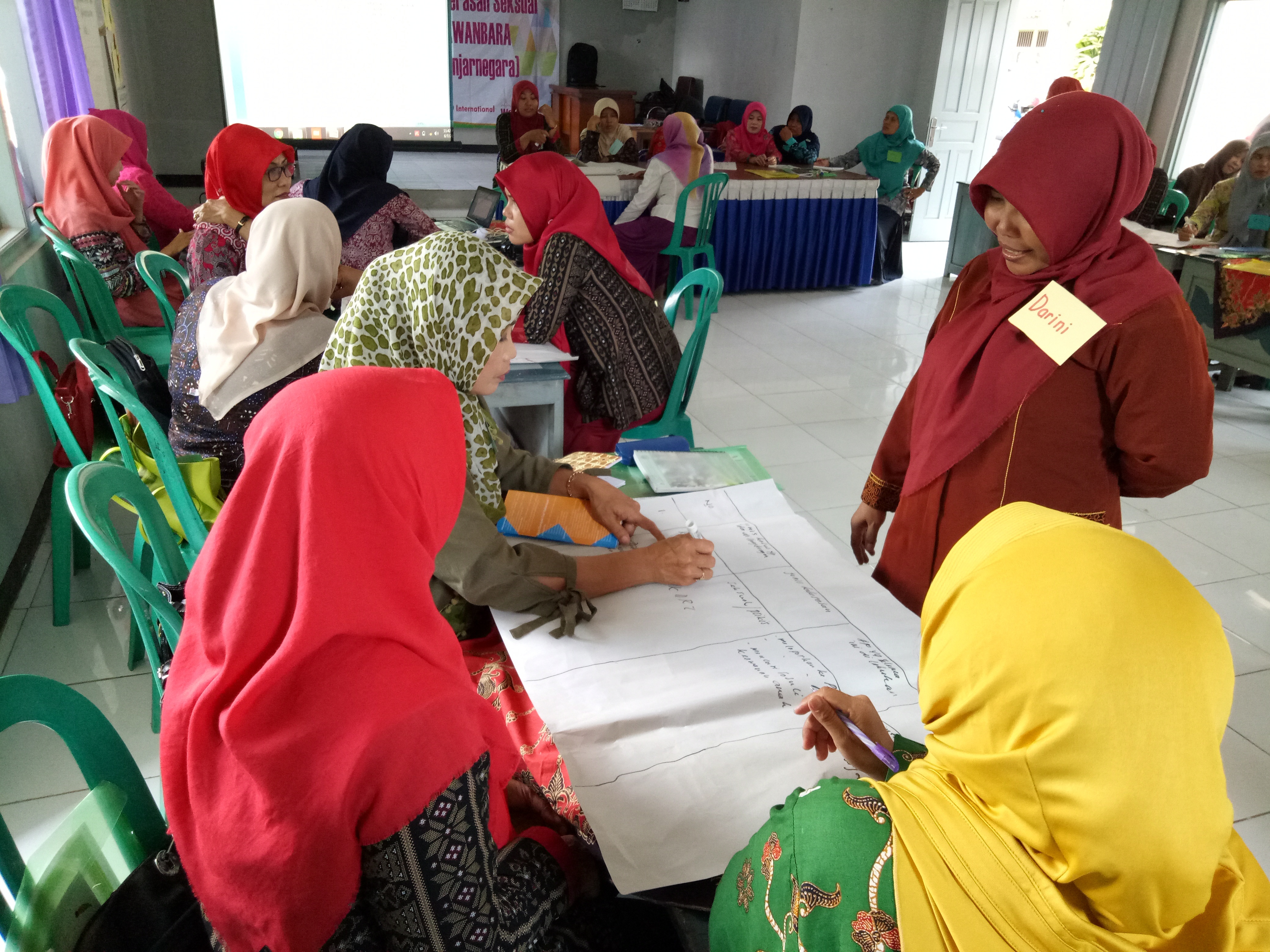
Rural area in Jogja, Salamrejo village, we have conducted women empowerment awareness,  setting boundaries and yoga session for women group P3A Rengganis from Salamrejo  village, P3A Srikandi from Sentolo village, and P3A Putri Arimbi from Demangrejo village. 

Women’s ability to express their needs and set personal boundaries is closely influenced by  cultural values such as being quiet or not asking too many questions is shown as respect, and  not causing a problem. These norms can make direct communication of personal limits  challenging, particularly in family or community settings where maintaining good  relationships is highly valued.  

In our work, as Mitra Wacana we aim to be guided by the voices and lived experiences of the  women we engage with. Since our activities are directed towards them, it is essential that 

their input shapes the way we design and deliver our sessions. When women face challenges,  our intention is to support them in recognising and addressing these in a safe and respectful  way. 

Many women initially experience speaking up as something  associated with fear, judgement, or being perceived as  disrespectful. There is often a belief that confidence is a  prerequisite for expression, and that needs should only be  communicated once a certain level of confidence has already  been achieved. In addition, expressing personal needs may  sometimes be associated with conflict or tension, which can  further discourage open communication. 

Fear of speaking up is a human response rather than a sign of weakness. Confidence does not  need to exist before expression; instead, it can develop gradually through the act of speaking  and being heard. In this sense, speaking up becomes not a confrontation, but a respectful way  of sharing needs, experiences, and boundaries. 

Reframing communication in this way supports a more empowering understanding of voice  and agency. It encourages the idea that authenticity and self-expression can coexist with  respect for others, and that empowerment is built progressively through practice, awareness,  and supportive environments. 

Communication is shaped by social expectations, the culture and what kind of family they  have grew up in. understanding these cultural and structural factors is important when  designing empowerment or educations sessions.  

Women’s voice matter, as an organization we want to see more women talking about their  needs and putting their opinions. Since our work is directed towards them, we want to be  guided by their input and experiences. If they are facing challenges, we want to support them  in addressing these issues. However, we recognise that they may have difficulties  communicating these needs, which is why we aim to increase awareness and provide  education around these topics. We as Mitra Wacana have conducted workshop about women  empowerment and boundaries. We also combined this approach with yoga as a supportive  and accessible way to create space for reflection, awareness, and empowerment. 

Understanding Boundaries 

One of the key topics we explored was boundary setting a vital part of self-care and healthy  relationships. Many women face challenges in expressing their needs due to cultural and  societal expectations. We have conducted a workshop for women and have discussed about  situations with the women in the village. Sometimes they forget their own voice and not be  able to talk about their needs. We discussed strategies to identify personal values, articulate  needs clearly, and practice saying no when necessary. Emphasizing boundaries helps women  gain confidence and improves their ability to navigate both personal and professional  relationships. 

How can you set these boundaries?  

•  Identify Your Needs and Limits 

Reflect on what makes you feel safe, respected,  and comfortable in different areas of life family,  community, work, and personal time. Awareness  of your own needs is the first step to expressing  them. 

•  Start Small 

Begin by asserting limits in low-risk situations, such as requesting personal space, expressing a preference, or politely declining minor requests. Gradually, confidence builds for larger or more challenging situations. You can also write these down and helps you become more aware and reflective while writing and changes the way  your brain processes or learns new patterns. 

•  Use Clear and Respectful Communication 

Practice stating your limits directly and calmly, without blaming or attacking others. For  example: “I need some quiet time right now” or “I am not comfortable discussing this topic.” 

•  Combine Words with Actions 

Boundaries are reinforced by consistent actions. If you set a limit, follow through respectfully  to demonstrate that your boundaries are important. Its important how you use your voice 

while saying it.  

•  Seek Support and Safe Spaces 

Share your experiences with trusted friends, community groups, or facilitators. Programs like  workshops and yoga sessions can provide safe environments to practice boundary-setting and  receive feedback. 

•  Reflect and Adjust 

After asserting a boundary, reflect on how it felt and how others responded. Adjust your  approach if necessary, maintaining both self-respect and relationship awareness. 

We conducted a joyful yoga session at the final part, we asked them a reflective question:  “What is one thing you could do to be kinder to yourself?” It is important for women to  prioritise their own needs first, because when children observe their mothers taking care of  themselves, they learn to value self-care as well. 

Moreover, the women should remember that by using their voices, they are inspiring others.  When one woman speaks up, she speaks not only for herself but also for other women,  creating a ripple effect of empowerment. This collective expression is where we believe real  change begins. 


Continue Reading
Advertisement NYL2026
Advertisement
Advertisement

Twitter

Trending